Tell us about the job
Takes about a minute. No obligation.
Compressor failures in Wright County rarely arrive without warning signs a contractor can trace. Homes in Wright County, MO run cooling about three months a year, from June through August. A short cooling season concentrates every start-stop cycle into a narrow window, so the contactor, the capacitor, and the compressor itself either hold through all of it or show the fault on one of the first hard days of June. A contractor repairing a system here looks at what those summer cycles have done to the refrigerant charge and the electrical components before quoting anything else.
Half the homes in Wright County, Missouri were built in 1978 or earlier (2020-2024 ACS 5-year). When a system in housing this old goes down, what a contractor finds once the unit is open determines everything about the repair path. Capacitors, contactors, and control boards for equipment that old may have limited availability, and a contractor pulling those parts has to confirm what is still made before pricing the job. The ductwork in houses like these was sized for whatever system came first, then adapted over time, which means a repair call can turn up airflow problems the failed component alone does not explain.
The Parts of a Central AC a Contractor Checks First
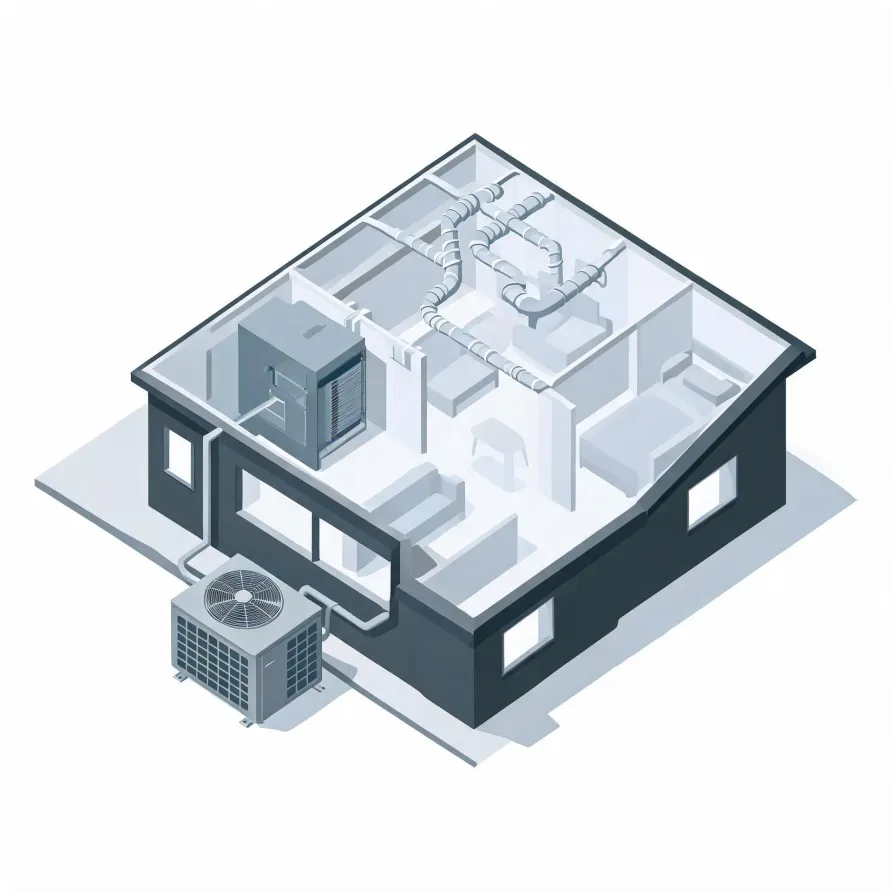
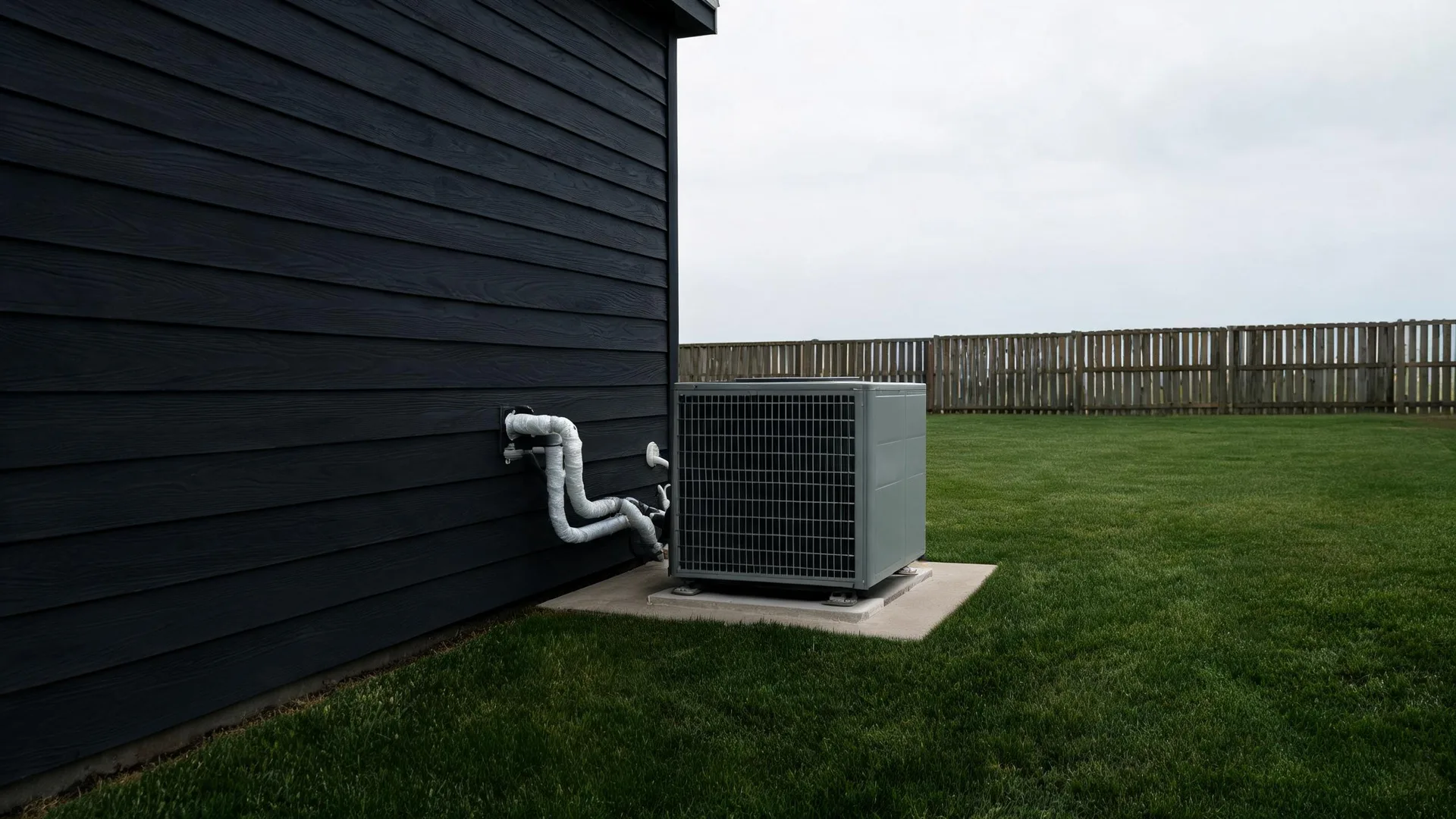
The outdoor condenser unit sits outside the house, usually on a concrete pad against an exterior wall, and it is where heat gets released. Inside, the air handler or furnace-mounted evaporator coil sits in a closet, basement, or utility room and is responsible for pulling heat out of the air that moves through your home. These are the two pieces a contractor reaches first when the system stops cooling.
The refrigerant lines run between those two units, and the expansion valve controls how refrigerant moves through the evaporator coil. The thermostat on the interior wall is where the whole sequence starts, so a contractor checks it early. A failed component anywhere in that chain explains most of what goes wrong with a central system.
The drawing shows a typical layout, and a licensed contractor determines which components apply to your specific house and setup.
Get matched in Wright CountyWright County, Missouri, by the numbers
129 severe weather events were recorded in Wright County, Missouri between 2015 and 2024.
NOAA National Centers for Environmental Information, Storm Events Database, bulk CSV export, events 2015-01-01 through 2024-12-31.Half the homes in Wright County, Missouri were built in 1978 or earlier (2020-2024 ACS 5-year).
U.S. Census Bureau, 2020-2024 American Community Survey 5-Year EstimatesWright County, Missouri holds 8,367 housing units (2020-2024 ACS 5-year).
U.S. Census Bureau, 2020-2024 American Community Survey 5-Year EstimatesOwners occupy 77.1% of the occupied homes in Wright County, Missouri (2020-2024 ACS 5-year).
U.S. Census Bureau, 2020-2024 American Community Survey 5-Year EstimatesRules & Standards Governing Central AC Repair in Wright County, Missouri8 sourced rules and standards
What Happens When the Contractor Shows Up
Split-system central air conditioners rated below 45,000 Btu/h manufactured on or after January 1, 2023 must meet a federal minimum of 13.4 SEER2.
Split-system central air conditioners rated at or above 45,000 Btu/h manufactured on or after January 1, 2023 must meet a federal minimum of 13.4 SEER2.
Split-system central air conditioners manufactured between January 1, 2015 and December 31, 2022 had to meet 13 SEER, the metric that preceded SEER2.
Single-package central air conditioners manufactured on or after January 1, 2023 must meet a federal minimum of 13.4 SEER2.
Space-constrained central air conditioners manufactured on or after January 1, 2023 must meet a federal minimum of 11.7 SEER2.
Federal efficiency standards for split-system central air conditioners and heat pumps are set on each certified combination of outdoor unit and indoor coil rather than on the outdoor unit alone.
Residential and light commercial air conditioning and heat pump systems assembled in the field, including mini-splits and unitary systems, may not be installed on or after January 1, 2025 using a refrigerant with a global warming potential above 700.
A field-assembled system whose specified components were all manufactured or imported before January 1, 2025 carries no installation compliance date under the refrigerant restrictions and may still be installed.
Severe Weather Events in Wright County
Weather puts a load on central AC equipment that indoor conditions alone never would. What happens outside in Wright County drives how hard the system runs, how often parts fail, and what a repair technician finds when the season ends.
129 severe weather events, 2015–2024. Source: NOAA National Centers for Environmental Information, Storm Events Database.